brainrot, art, and decay
My friend told me a funny story the other night about her 13 year-old brother’s most recent home science experiment. After a curious and putrid smell was detected in his bedroom by another sibling, it was discovered that he had left a sandwich enclosed in a Lego box under his bed, later justifying his actions by stating:
“I just wanted to create my own ecosystem.”
This story came up during a discussion among friends about the phenomenon of screen time for children and the possibility of it causing developmental delays especially due to excessive and early exposure. We hypothesized about the next generation lacking social skills and creativity due to growing up in a loud, colorful, and prepackaged world. As educators and relatives to them, we shared our own experiences with how children “nowadays” tend to interact. There was an old fogeyness about this conversation in 2025 between three people born in the mid 1990s, but my reaction to this particular story was rather positive. I liked hearing about my friend’s brother’s gross misadventure. Or was it a successful biological and teleological experiment? It was reported that visible fungi and mold of various kinds had grown; he had in fact played god and created his own new world from a sandwich. It was a signal to me that young people are still curious, funny, and developing in their own unique ways of navigating this world along with the rest of us despite the brainrot spewing from all our digital device appendages.
✿
My artist friend recently proposed a concept for a cybernetic organ: a human gizzard implant that can digest microplastics. I thought it to be more utilitarian if perhaps the gizzard could create a new plastic product, post-digestion of course. They then hypothesized that if everyone gets this implant, which will surely be crucial one day for humanity’s survival as our bodies continue to be exposed to more and more microplastics, that we would mutate and evolve and eventually be born with such an organ. I’m not a scientist, but my guess is that it is more plausible that humans would develop a type of microplastic gizzard or a way to digest plastic in food (or just plastic food) more quickly through natural selection without the assistance of an implant. We agreed that in the meantime the implant could be a successful little product. At the conclusion of our discussion, it was clear to us both that the accelerationist dream of the Microplastic Gizzard™ might someday become a reality.
✿
Speaking of mold and microplastics, I recently visited the Staten Island Museum for the public opening of their latest exhibition Breakdown: The Promise of Decay. I was excited about this exhibition featuring mushrooms and landfills since the first e-blast blasted to my inbox a few months ago. In my life and career I have held a few roles at the Museum and I’m extremely fond of the institution and its people which may lead to a biased account of the new exhibition, but this is not meant to be a review, anyway.
Breakdown: The Promise of Decay, dives into the “vibrancy of decay,” examining “time, waste, and the in-between” through contemporary artworks, objects, and scientific innovations. I was drawn to artist Tamara Kostianovsky piece Lengthwise, 2021, a meat-like log made of the artist’s own discarded clothing, drawing upon themes such as the contemporary overconsumption of textiles and the Argentinian meat and logging industries’ colonial roots.

Discarded clothing and other textiles, wood, 2021
Photo courtesy of the author
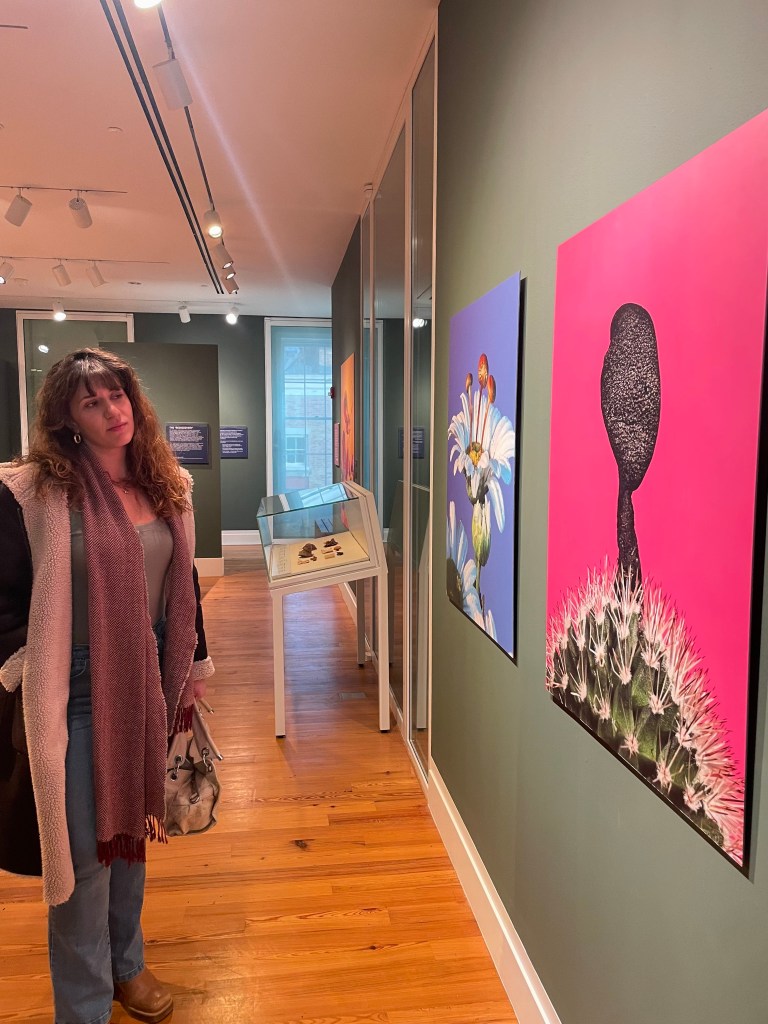
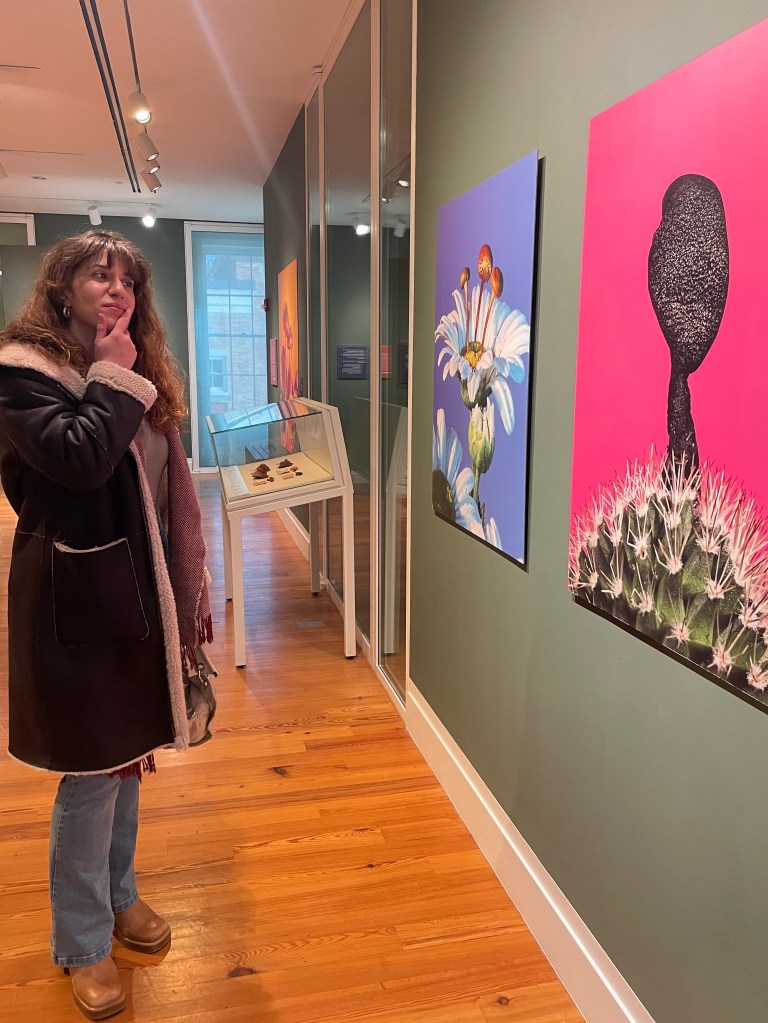
The interdisciplinary nature of the exhibition reflects the Museum’s nearly 150-year commitment to an ever-evolving perspective on art, science, and history. Selin Baci’s Contamination Series “66”, 2025 pictured below, evoked a visceral fear within me. I am totally freaked out by mold and infectious disease. Even though the mold was dead and fossilized in the epoxy, a carbon image of a once living agent of decay, I felt sick. Well done! Art is supposed to make you feel something right?

Mold spores on panels covered with epoxy, 2025
Photo courtesy of the author
Throughout these recent conversations with friends and with myself as I walked through the gallery this weekend, I was reminded of the slow, quiet, and transformative nature of life. A sandwich becomes the host to a new ecosystem of detritivores in a tween’s bedroom without much fanfare; accelerated natural selection via market access to a cybernetic organ implant might one day be the solution to microplastics in our food but a disaster for human rights; at the Staten Island Museum, mushroom glamour shots plaster the walls and the Earth’s pulse makes soft, hardly perceptible beeps and boops ready to be mixed into a DJ set with the right sound equipment, while toxic trash juice flows through the hills and valleys of a landfill, routed and redirected by forbidden pool noodles (you’ll have to visit the exhibition to know what I’m talking about).
✿
The moral panic around youth being corrupted by the technology of the day is age-old, although there is plenty to be concerned about now to ensure a promising future for them on this planet. The proposal for human physical adaptation to a sick environment, such as a microplastic gizzard, is meant to be horrifying and absurd, but if the conversation is taken to its logical conclusion, it doesn’t appear so strange and far-off after all. Perhaps my artist friend should go ahead with their designs for this nightmare product and such a sculpture could trigger an important conversation about the direction of the global market and its human impact, most egregiously on access to safe water, food, and sanitation. But also fears of being starved of access to creativity and expression during a time of decadence and decay permeate the landscape. If humans have already created so many bad things, shouldn’t we just stop making new things altogerher?
The Museum’s exhibition invites viewers to listen, look, and play with dark themes; the death, decay, and waste of environmental catastrophe. With the help of the bright colors, sounds, and textures of science, from the natural cycles of the organic world to manmade systems and materials, the exhibition invites viewers to see the promise of creativity when things fall apart. Art remains an essential tool for making our greatest dreams and fears come into frame for interpretation, response, and action.
 Jacqueline Grace Caruso
Leave a comment